Ties That Bind: A Values-Driven Approach to Evolving Evaluative Practice

A growing number of new initiatives are seeking to transform philanthropic evaluation in ways that can better support them and the social change they are after. We represent three of these efforts.
Equitable Evaluation Framework Applies to all Evaluation

It can be hard to understand how equitable evaluation applies to any evaluation, even for strategies that do not explicitly focus on advancing equity. Julia Coffman writes about her “aha” moment, when she realized that equitable evaluation should be at the center of all of her work.
What Will it Take for Philanthropy to Learn?

Learning leaders from fourteen foundations participated in a year-long “Lab for Learning” to experiment with and test ideas for supporting learning in foundations. Several “ground truths” guided this work.
5-A-Day: Learning By Force of Habit

Establishing a learning organization or culture is such a big goal that it can overwhelm our ability to act on it. This piece, published on Medium, explores how building learning habits into common routines makes it more manageable, and creates small wins that can lead to big change. Focusing on habits ensures that learning is not a separate activity, but rather is integrated into our day-to-day work.
Between the Devil and the Deep Blue Sea: The Consequences of Small Failures in Learning

It was the worst U.S. maritime disaster in three decades, involving an experienced captain with a reputation for safety. This article, published on Medium, explains went wrong and what it can teach us about the often-overlooked factors that affect our learning and decisions.
Better, Faster, Results – Supporting Learning for Multiple Audiences

How can foundations build an approach that is connected to robust data and information and supports the many learning needs of multiple actors? This presentation for the 2017 Evaluation Roundtable convening is on strategies for supporting learning in philanthropy. It presents questions, challenges, and implications for foundation practice.
FaceTime, Open Workspace, and Electronic Calendars are a Few of My Least Favorite Things: Learning and the Way We Work

Supporting learning is about much more than facilitation and what happens at learning-focused events or meetings. We have to expand our thinking about what it takes to support effective learning in philanthropy. This article on Medium explores some unexpected sources, such as time management, physical and virtual space, and technology.
How Do You Measure Up? Finding Fit Between Foundations and Their Evaluation Functions

Foundations need to think carefully about how the structure, position, focus, resources, and practices of their evaluation functions can best fit their own needs and aspirations. This Foundation Review article, based on 2015 benchmarking research, poses questions foundations can ask to assess what they need from an evaluation function, and common areas of misalignment between needs and approaches.
Benchmarking Foundation Evaluation Practices: 2015 Benchmarking Data

The result of a partnership between the Center for Effective Philanthropy and Center for Evaluation Innovation, this report offers a comprehensive look at foundation evaluation practices, based on 2015 survey data from 127 senior evaluation and program staff at foundations.
Oh for the Love of Sticky Notes! The Changing Role of Evaluators Who Work with Foundations
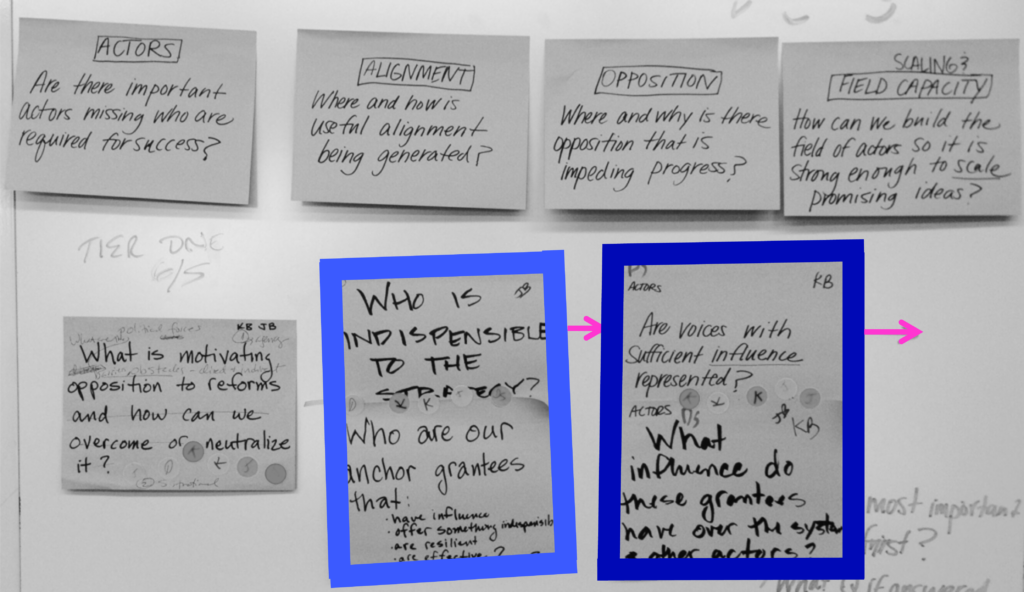
Julia Coffman, founder of the Center for Evaluation Innovation, illustrates evaluators’ changing roles in the context of her own experiences as a long-time evaluator in philanthropy. This article published on Medium examines the history of evaluation in philanthropy, and the implications of role changes for evaluator skills, expertise, and boundaries.